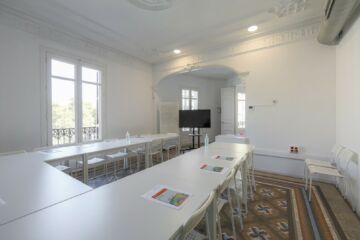
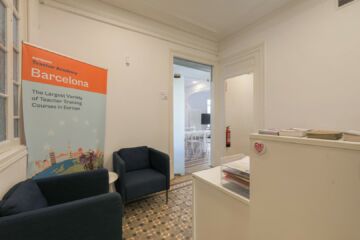
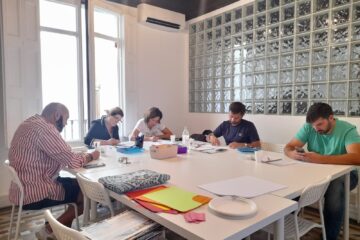
Please note that while these services apply to most courses, exceptions may occur. Even in locations where we have dedicated classrooms, we may occasionally need to rent external spaces nearby, and the availability of services may vary. Kids, pets, or guests within the school premises must be approved by email each time. Whether or not our premises are marked as wheelchair accessible, we kindly ask you to inform us in advance. If accessibility is an issue, we will arrange for an external classroom to accommodate your course. If you have any questions, please don't hesitate to reach out to us.
Our Cultural Activities
The following cultural activities are included in the price of each Erasmus course in Spain:
A guided tour of Barcelona
Follow our teacher trainers for an informal, fun, and pleasant walking tour in one of the most special districts (“Barrio” in Spanish), the Gracia Barrio. During the tour, you may meet Erasmus + teachers from other courses (if applicable) and decide to stay for some delightful tapas.
During the walking tour, you will walk around the Gracia Barrio. This is a residential, creative, hipster district of Barcelona, which displays mainly original Modernist buildings (inhabited by residents still!), and is home to the first house that Antoni Gaudí built in his career, Casa Vicens.
Here you can appreciate the styles that influenced his artistic development, and discover details about life in Gracia in the 20th century. Then you will walk towards the many Modernist streets around, and reach the many little squares that characterize the district, such as Plaza del Diamant,Plaza Virreina, and Plaza de la Revolución. The history of Saint John’s Church in Virreina Square will be explained to you, where you will find a Modernist Chapel designed by Francesc Berenguer, Gaudí’s assistant, sometimes open to visitors.
Bus hop-on hop-off (2 hours)
The “Bus Turistic” is one of the most comfortable and practical ways to explore the city’s most iconic attractions. With a single ticket, you can hop on and off as many times as you like throughout the entire day, allowing you to discover Barcelona at your own pace.
The service operates along two different routes — the Red and Blue lines — covering over 30 key landmarks, including the Sagrada Família, Park Güell, Casa Batlló, La Pedrera, Camp Nou, the Gothic Quarter, and the beach areas. Buses run frequently, and you can switch between lines at several connecting stops.
Each double-decker bus offers an open top for panoramic views, as well as a multilingual audio guide system with headphones included, so you can learn about the city’s history, architecture, and culture while you travel.
Free Wi-Fi is also available on board. The full circuit takes approximately 2 hours, but you are free to take as long as you wish, getting on and off at any stop, as many times as you like within the same day.
Another cultural activity in Barcelona or its surroundings
Barcelona has so many sites to see that one week may be too short to enjoy all its architecture, art, food, nightlife, nature, and beach life. The following cultural activities are planned to be held on Saturday, or during the week at your best convenience, upon availability.
The Sant Pau Modernist Enclosure, after serving for a century as a public hospital, its rehabilitated pavilions now shine in all its glory. Visiting this exceptional architectural complex is a unique experience.
In the Casa Museu Amatller, you can see the transformation from a traditional society based on the old regime to a much more open, dynamic one typical of the industrial and contemporary world of the early 20th century.
It is an open-air architectural museum located in Barcelona. It showcases replicas of buildings from different regions of Spain, allowing visitors to experience the country’s diverse architectural styles in one place. The site also features artisan workshops, exhibitions, restaurants, and cultural events, making it a lively space where history, art, and tradition come together.
Our Academy in Barcelona
European Academy of Creativity, the company in charge of delivering courses in Barcelona, is legally established in Spain and operates under accreditation by Europass Foundation.
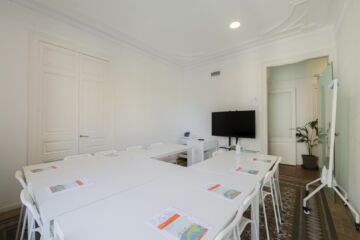
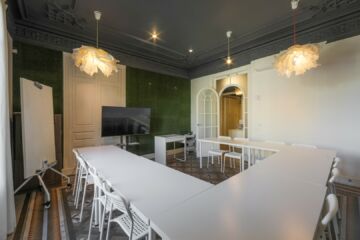
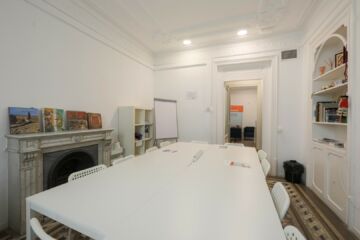
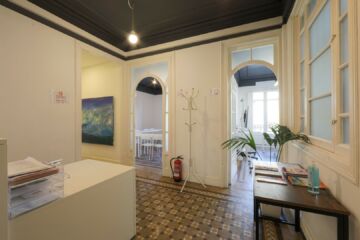
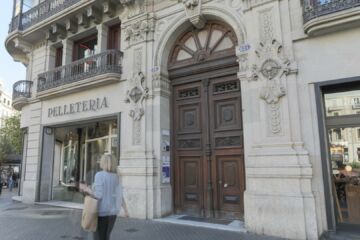
Our teacher training center is located in Rambla Catalunya, one of the most beautiful and elegant streets in Barcelona. Just a few steps from the vibrant Plaza Catalunya and the modernist Passeig de Gracia, the school location is perfectly connected with the main cultural sites and different areas of the city, and offers a variety of attractive monuments, shops, and restaurants you can enjoy after the lesson.
The palace is a Finca regia modernista catalogada, a “royal cataloged Modernist building”, as you will appreciate from the beautiful floral and geometric decoration around the stairs and the original floor in each of the rooms of the school.
Barcelona’s course schedule
All our teacher training courses in Barcelona will take place either in the morning (9.00-14.00) or in the afternoon (14.00-19.00), depending on classroom and trainer availability.
The final schedule will be sent two weeks before the course begins. We recommend planning any cultural activities only after receiving it.
Photogallery
How to reach us
Since the school is only a few steps from Plaza Catalunya and Passeig the Gracia, all trains, busses, and metro lines offer a perfect connection to it.
Getting to Barcelona
Barcelona is served by the main airport of Barcelona-El Prat Airport (BCN), and Girona-Costa Brava Airport (GRO).
The first one is located about 12 kilometers southwest of the city center and handles the majority of commercial flights, both domestic and international.
While not located directly in Barcelona, Girona-Costa Brava Airport is situated approximately 92 kilometers northeast of Barcelona. Some budget airlines offer flights to Girona as an alternative to Barcelona-El Prat Airport. However, travelers should note that Girona Airport is further away from the city center and requires additional transportation to reach Barcelona.
Acquire a set of drawing and painting techniques to use in your private or in your school life. Gain more confidence in your artistic capacities and discover how to incorporate creativity into your teaching practice in a non-judgmental way.
Brain-Centered Activities for Focus and Well-Being in Primary Education
Acquire a solid knowledge of the artistic and architectural panorama in Barcelona. Practice a variety of engaging learning activities (such as Visual Thinking Strategies, sketching, and Catalan mosaic making), to engage the classroom.
Brain-Centered Activities for Focus and Well-Being in Primary Education
Learn how to stimulate the students’ motivation by experiencing an environment in an unusual way, focusing on personal experience acquired in Barcelona.
Gain the knowledge and skills to embrace your role in an AI-driven world and utilize AI tools to enhance student learning. Learn practical strategies for identifying struggling students, creating intelligent tutoring systems, and automating tasks like grading.
Brain-Centered Activities for Focus and Well-Being in Primary Education
Explore hands-on activities designed to prevent isolation and disruptive behaviors, with a focus on interaction and support. Discover effective relaxation techniques and movement-based activities suitable for special needs students and the entire class.
Brain-Centered Activities for Focus and Well-Being in Primary Education
Acquire an understanding of group dynamics by discovering how tensions, alliances, and relational struggle can interfere with learning. Learn to encourage active listening, empathy, and emotional literacy.
Brain-Centered Activities for Focus and Well-Being in Primary Education
Discover how incorporating yoga practices can enhance your ability to maintain a favorable climate and support resilience both in and out of the classroom. Explore useful tips on introducing children and teens to yoga and meditation techniques.
Brain-Centered Activities for Focus and Well-Being in Primary Education
Gain an understanding of the responsibility to cultivate resilience strengths in order to attain a stable state of well-being. Explore strategies such as emotional management, fostering a positive mindset, and cultivating empathy and compassion.
Brain-Centered Activities for Focus and Well-Being in Primary Education
Engage in well-being and mindfulness activities outdoors, around city parks and gardens, and delve into nature-inspired activities during classes. Design a physical space and program to integrate nature into lessons and the school environment.
Brain-Centered Activities for Focus and Well-Being in Primary Education
Recommended Audience: Administrative Staff, School Principals
Language RequirementsB1 (Intermediate)
Enhance English language proficiency, both written and spoken, for effective communication in administrative tasks, professional interactions, and cultural immersion.
Brain-Centered Activities for Focus and Well-Being in Primary Education
Discover effective stress-management strategies, focusing on emotional intelligence and regulation. Learn how to cope with your own stress and know how to implement these tools in your school to reduce the stress levels of the students.
Brain-Centered Activities for Focus and Well-Being in Primary Education
Recommended Audience: Administrative Staff, School Principals
Language RequirementsA2 (Elementary)
Improve your English skills to communicate more clearly and confidently in school settings. Develop fluency in speaking, listening, reading, and writing, and expand your vocabulary related to school and office tasks.
Brain-Centered Activities for Focus and Well-Being in Primary Education
Learn to develop your own course of action for promoting Social and Emotional Learning in the school through reflection, sharing experiences, and creating a unique path tailored for your school community.
Brain-Centered Activities for Focus and Well-Being in Primary Education
Encourage a mindful and eco-conscious art and nature approach through indoor and outdoor activities using natural ingredients, low-impact supplies, and recycled objects.
Brain-Centered Activities for Focus and Well-Being in Primary Education
It was an excellent experience! We were trained in very interesting subjects that will help us in school. The hospitality at the host organization Europass Teacher Avademy was perfect! Also the cultural activities and Amsterdam unforgettable!!!
Europass Teachers Academy is a company that suit perfect our needs. We attend courses for the third time and each one is well organised and interesting to attend. Teachers make the lectures both useful and thrilling.
Special thanks to Mathieu Delamarre! I love the way… More he presented the lectures and all people in the group had fun during the course!
What a great time I had in Barcelona! I fell in love with the city, its cuisine and uniqueness. I was fascinated with Marta's enthusiasm and knowledge. She created a magic atmosphere in our group. The level of both Mindfulness and yoga courses was high. I could… More learn plenty of useful things. Besides, I had a chance to meet wonderful people from various countries. I am going to attend Erasmus + course next year, for sure.
Yannella fantastic, prepared and available. The activity at the museum beautiful. I found myself well with you clean and fresh premises!!! Thanks for everything Giusy
An Unforgettable Erasmus Experience at Europass Teacher Academy, Barcelona
I had the incredible opportunity to attend the Erasmus+ course "Successful Strategies for Teaching Students with Special Needs in Every Classroom" at Europass Teacher Academy in Barcelona—and… More it was truly one of the most enriching professional and personal experiences I've ever had.
The course offered a perfect balance of high-quality learning and cultural discovery. I gained valuable strategies and tools to support students with special needs in inclusive classroom settings, all while exploring the vibrant and inspiring city of Barcelona.
A special mention goes to our amazing trainer, Sonia Sola Gil, General Health Psychologist and Art Therapist. Her approach was gentle, insightful, and incredibly effective. She explained everything with clarity and warmth, combining theory with practice in a way that made learning engaging and meaningful. Her teaching techniques, empathy, and kindness truly stood out and left a lasting impression on all of us.
Beyond the learning, what made this course exceptional was the sense of connection and collaboration. I formed deep and lasting bonds with fellow educators from across Europe, and I left not only with new skills, but also with friendships and memories that I’ll always cherish.
I highly recommend Europass Teacher Academy to any educator looking to grow professionally while immersing themselves in a rich cultural experience!
It was a wonderful experience. Paula Rodriguez - an exceptional trainer, the course followed - interesting and attractive. Interesting and interactive activities, special people. Thank you all for this opportunity!
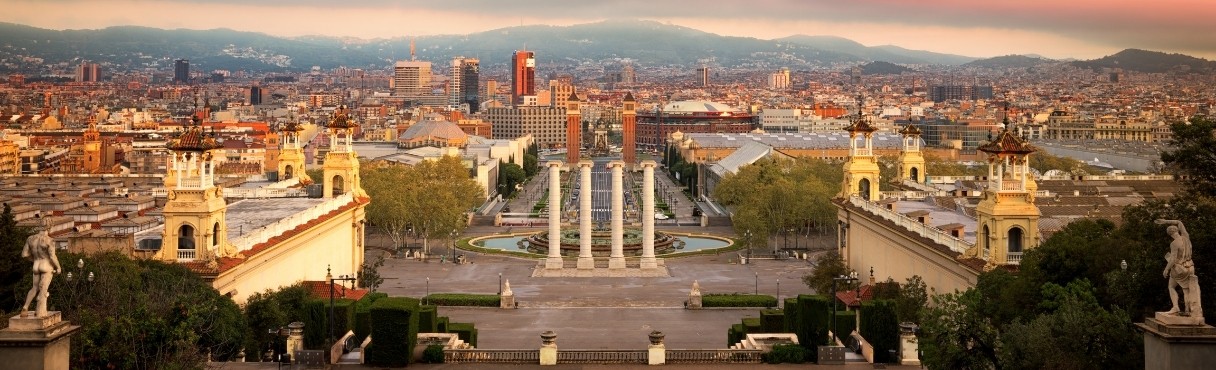
On the coast of northeastern Spain, Barcelona is the capital and largest city of the autonomous community of Catalonia, as well as the second-most populous municipality of Spain, with a population of 1.6 million people within city limits.
Particularly renowned are the architectural works of Antoni Gaudí and Lluís Domènech i Montaner, which have been designated UNESCO World Heritage Site, the Gothic Quarter of the city, and museums devoted to important artists that had been inspired by Barcelona as Pablo Picasso and Joan Mirò.
Nature and sport play a distinctive role in Barcelona, surrounded by long beaches in Barceloneta, Mar Bella, and many others just outside the city, hilltops and forests, such as Montjuic Hill and Tibidabo mountain which make the city the perfect place for hiking, biking, kayaking, stand-up paddleboarding, swimming or sunbathing. Definitely, Camp Nou, Barcelona’s Football Stadium, is a must-see for all football Barcelona FC supporters!
Barcelona is also a paradise for lovers of food and nightlife! On every corner, you can find a variety of high-quality restaurants with traditional Catalan and Spanish dishes and drinks, such as tapas, paella, fideuà, Cava, and Sangria, but also authentic cuisine from all over the world. Every night, live concerts and shows in open-air venues, vintage concert halls, and eclectic buildings transform the city into a complete 24-hour experience.
1. Casa Batlló
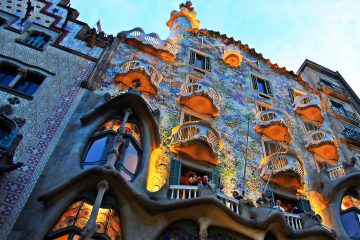
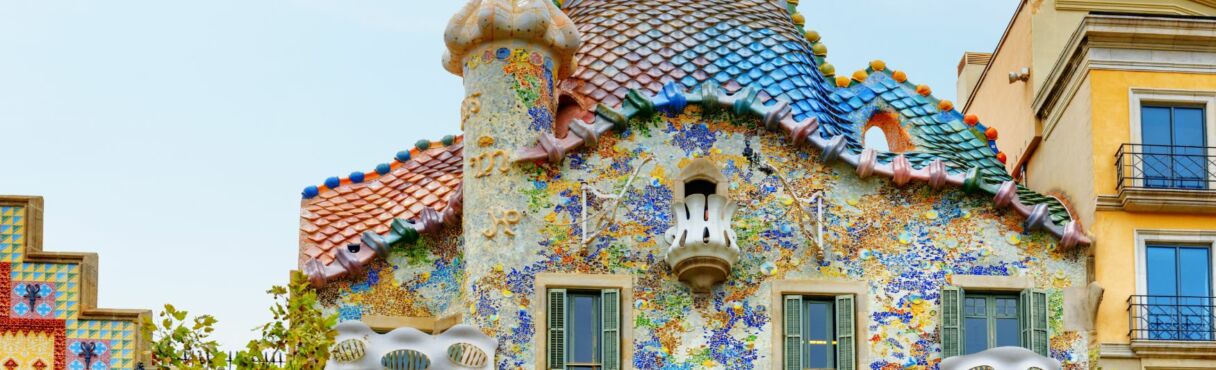
One of the most famous modernist buildings, Casa Batlló (reformed by Antoni Gaudi between 1904 and 1906), captivates passers-by along the elegant Passeig the Gràcia boulevard.
On the facade, multicolored glazed ceramics and stained glass form floral patterns and water lilies and shine with the reflections of the sunlight or night light. Inside, modernist furniture and details are combined with blue ceramics and glasses.
2. Sagrada Familia
For an aesthetic and spiritual experience, a visit to Sagrada Familia is definitely worth it. Fruit of the work of genius architect Antoni Gaudí, the project began in 1883 and today construction still continues on the Basilica and is expected to be completed in 2026, 100 years to coincide with the 100th anniversary of Gaudi’s death.
As per Gaudi’s will “Sagrada Familia is made by the people and this is reflected in it. It is a work that is in the hands of God and the will of the people”. As a matter of fact, the work is directly financed by donations made by visitors and the general public, which explains its slow construction progress.
3. Park Güell
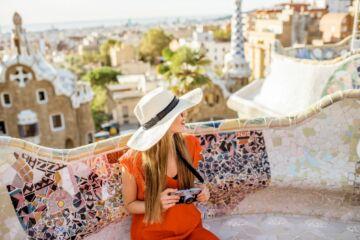
No work by Gaudí better explains the genius’s concept of the fusion between nature and architecture than Barcelona’s Park Güell. Gaudí’s Park Güell reveals the perfect interaction between the natural landscape and architectural building and details.
Initially created to host a housing estate in a natural setting in the old village of Gràcia by Eusebi Güell, between 1900 and 1914, the park is now one of the most unusual parks in the world.
4. La Pedrera (Casa Mila)
Casa Mila (1906-1912) is one of Antoni Gaudi’s most iconic works of civic architecture. The building is more popularly known as “La Pedrera”, a Catalan word for ‘stone quarry’, due to its exterior similarity to one.
The facade simulates a rolling sea, adorned with iron balconies largely designed by Josep Maria Jujol, from wave to wave.
Inside, you can find furniture from that period and ornamental elements designed by Gaudí. On the rooftop, ventilation towers and chimneys are covered with the particular technique of trencadís mosaic of ceramic tiles, stone, marble, and glass.
5. Palau de la musica Catalana
The Palau de la Música Catalana is today an incredible venue for concerts and also a breathtaking building to visit.
It was built between 1905 and 1908 by the modernist architect Lluís Domènech I Montaner, as a home for the Orfeo Català (a choral society based in Barcelona) and is a great architectural jewel of Catalan Art Nouveau.
6. The Gothic Quarter
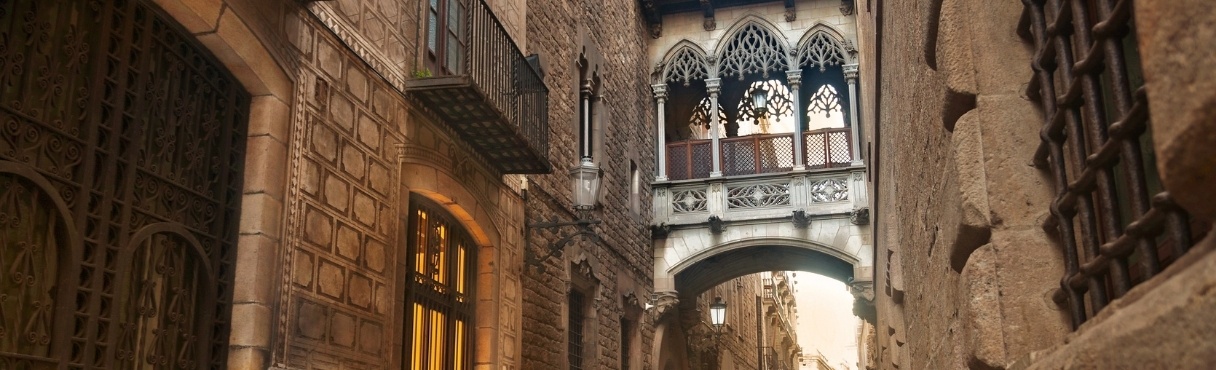
The Gothic Quarter is the historic center of the oldest parts of the city of Barcelona. It retains a labyrinthine street plan, with many narrow streets opening out into picturesque squares.
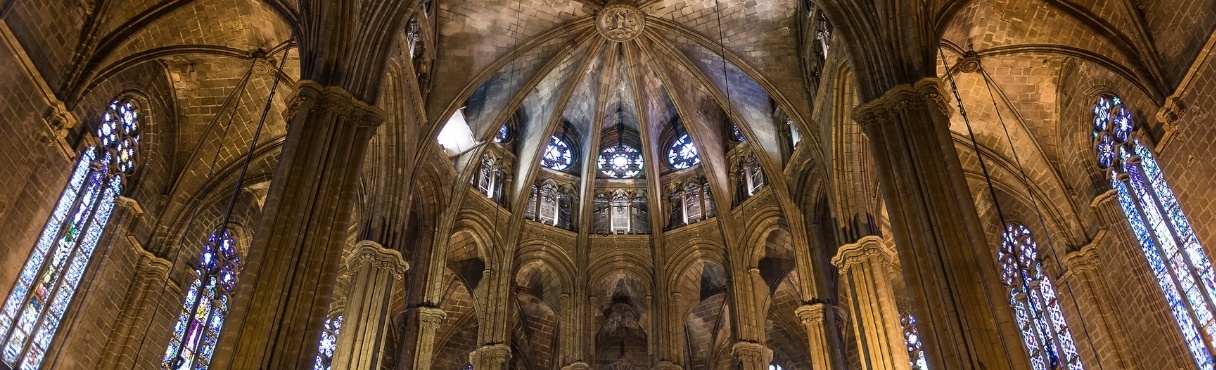
In the Gothic quarter, you can admire the remains of the city’s Roman wall, several medieval landmarks, and the Gothic cathedral. Among the main sites, are the Barcelona Cathedral (Cathedral of Santa Eulalia), the Pignatelli Palace (at present-day Royal Artistic Circle of Barcelona), Santa Maria del Pi Church, Plaza Sant Jaume, Picasso Museum, and the dynamic Plaza Real.
7. Picasso Museum
Located in the Gothic Quarter, the Picasso Museum of Barcelona hosts more than 4.000 works of the artists, most of them from the formative years up to the Blue Period. Opened in 1963 the museum reveals his deep relationship with the city of Barcelona which lasted throughout his life.
The Joan Miró Foundation is a museum of modern art dedicated to the Catalan artist Joan Miró, which is located on Montjuïc Hill. The building is an example of rationalist Mediterranean architecture, designed by the architect Josep Lluís Sert, following Joan Miró’s instructions to create a space that would encourage artists to experiment with contemporary art.
Many of the artworks displayed in the building were donated by the artist himself, and represent all the main phases of his artistic development, mainly inspired by Surrealism, Fauvism, and Expressionism, and culminating in the creation of a unique artistic profile.
The Basilica of Santa Maria del Mar was built from 1329 to 1384, designed by Berenguer de Montagut, and was considered the place of devotion for merchants of Gothic Barcelona.
It is also known as the “Cathedral of La Ribera”, since it is located in La Ribera district of Barcelona and is the only surviving church in the pure Catalan Gothic style.
10. MNAC – Museum of National Catalan Art
The Museu Nacional d’Art de Catalunya, abbreviated as MNAC, is the national museum of Catalan visual art located on Montjuïc Hill near Plaza Espanya.
The museum contains works of art from the 10th to the 20th century and is especially renowned for its outstanding collection of Romanesque church paintings, and for Catalan art and design from the late 19th and early 20th centuries, including modernism and noucentisme.
Open to enrollments means the course is pending confirmation. You can register now to help confirm this session, but you will need to wait for our confirmation before booking flights and accommodation.
Fully Booked means this session has reached maximum capacity and is no longer accepting new enrollments.
Confirmed means this session has reached the minimum number of participants and is guaranteed. However, you will still need to wait for our confirmation before booking flights and accommodation.

 Please wait, we're loading the information about the courses. It could take few seconds.