Please note that while these services apply to most courses, exceptions may occur. Even in locations where we have dedicated classrooms, we may occasionally need to rent external spaces nearby, and the availability of services may vary. Kids, pets, or guests within the school premises must be approved by email each time. Whether or not our premises are marked as wheelchair accessible, we kindly ask you to inform us in advance. If accessibility is an issue, we will arrange for an external classroom to accommodate your course. If you have any questions, please don't hesitate to reach out to us.
Our Cultural Activities
The following cultural activities are included in the price of each Erasmus course in Gdańsk:
A guided tour of Gdańsk
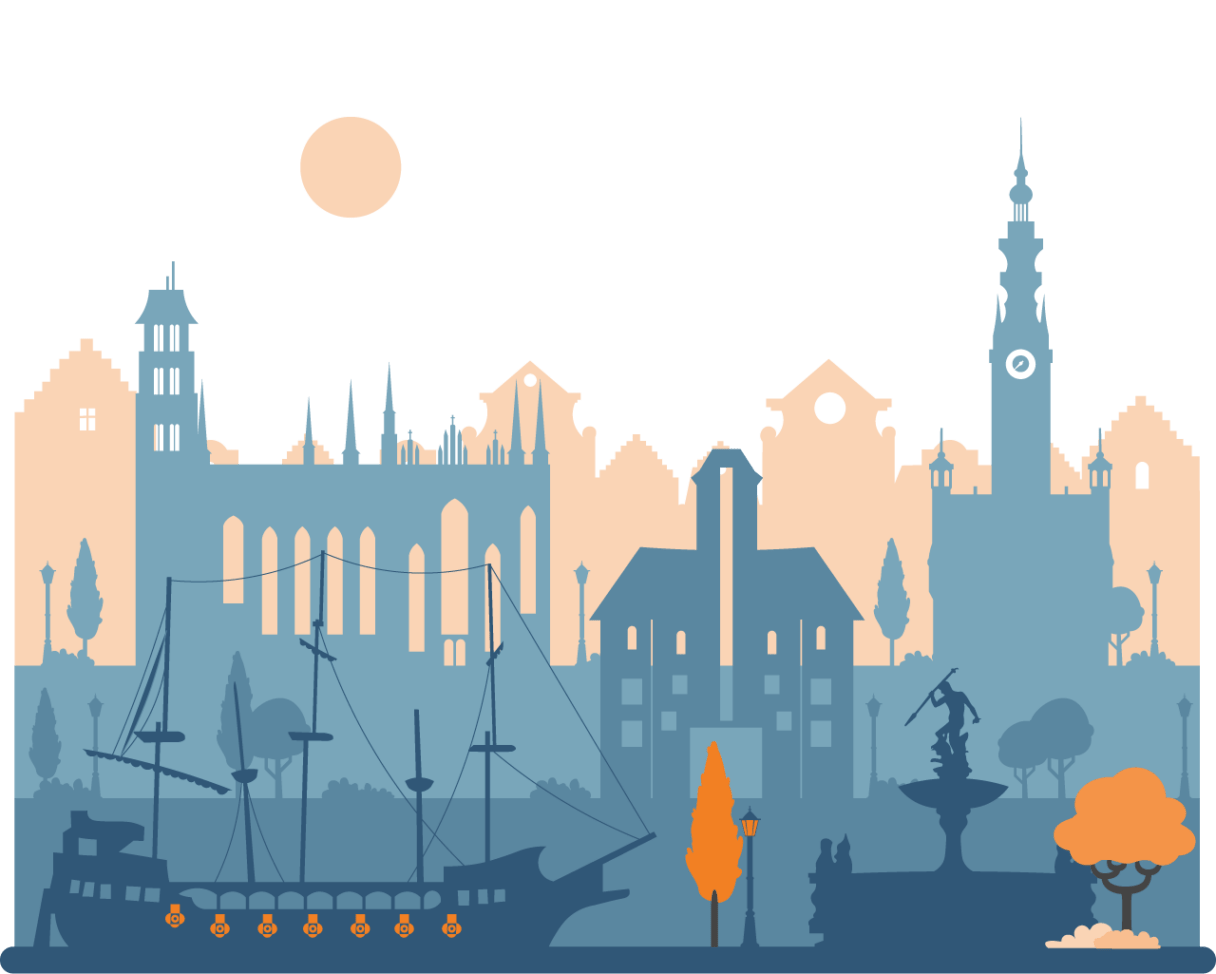
The tour is a guided walk through Gdańsk along the Royal Route, the city’s most representative street once used by Polish kings and visiting dignitaries. It begins at the Golden Gate, continues along Long Street, and ends at the Green Gate overlooking the Motława River. Along the way, visitors can admire the most important landmarks of the Main Town, such as the Main Town Hall, the Artus Court, and the Uphagen House. It is the heart of historic Gdańsk, full of cafés, restaurants, and colorful townhouses that have attracted tourists for centuries.
Duration: 1.5 – 2 hours Starting time and day: usually planned on Tuesdays Meeting point: Brama Wyżynna (High Gate)
Audio Guide of Gdańsk
The Audio Guide of Gdańsk offers a rich and flexible way to explore the city. You can choose from 40 audio tracks covering 20 locations, available in four different languages. Along the way, your guides include fascinating historical figures such as Emperor Napoleon, the renowned astronomer Johannes Hevelius, and even Neptune, the legendary King of the Seas.
The audio guide does not limit your visit or impose a pre-planned route. Instead, you are free to select your own trail and create a sightseeing plan that suits your interests and pace. Combine convenience with pleasure as you walk around Gdańsk—each must-see location is within a maximum 20‑minute walking distance from the Visitor Center.
72‑Hour Public Transport Ticket or Motława River Cruise
You can enhance your stay by choosing either a 72‑hour metropolitan public transport ticket or a relaxing Motława River cruise.
The 72‑hour ticket allows unlimited use of public transport across Gdańsk, Gdynia, and Sopot for three consecutive days, covering buses, trams, and selected trains within the metropolitan area—ideal for flexible and cost‑effective travel.
Alternatively, the Motława River cruise offers a unique perspective of Gdańsk from the water, allowing you to admire the city’s historic waterfront, shipyards, and landmarks while enjoying a calm and scenic journey.
Our Academy in Gdańsk
Fundacja NOVA, the company in charge of delivering courses in Gdańsk, is legally established in Poland and operates under accreditation by Europass Foundation.
Our Academy in Gdańsk is located across several carefully selected venues in Gdańsk and the nearby seaside town of Sopot.
The Gdańsk Academy combines historically and socially significant institutions with modern, well-equipped spaces, reflecting the spirit of the city and its strong connection to democracy, freedom, and community.
The main courses of the Gdańsk Academy are held at the European Solidarity Centre, a modern cultural and educational institution located in the heart of the city. Dedicated to the history of the Solidarity movement, the ECS symbolizes values such as freedom, democracy, social dialogue, and international cooperation, and is closely associated with Lech Wałęsa, Nobel Peace Prize laureate.
Additional courses take place at the Community Center Chełm, a local hub operated by the NOVA Foundation. The center supports educational, cultural, and social initiatives, promoting lifelong learning, social inclusion, and local community engagement.
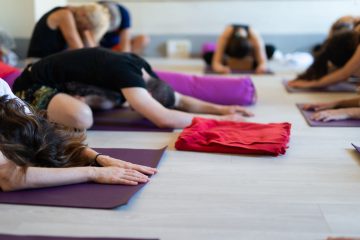
Selected well-being and yoga activities of the Gdańsk Academy may take place at a professional yoga studio located in Sopot near the beach in the seaside. The studio offers a calm, modern, and fully equipped space, providing an ideal environment for mindfulness, movement, relaxation, and stress-relief activities.
Gdańsk’s course schedule
All our teacher training courses in Gdańsk will take place either in the morning (9.00-14.00) or in the afternoon (14.00-19.00), depending on classroom and trainer availability.
The final schedule will be sent two weeks before the course begins. We recommend planning any cultural activities only after receiving it.
Photogallery
How to reach us
The primary airport serving Gdańsk is Gdańsk Lech Wałęsa Airport (GDN) and it has direct flights from many European cities.
You can easily reach the city center from the airport by various means of transportation, including trains, buses, shuttle services, taxis, uber, and car rentals.
You can also reach Gdańsk from Sweden by ferry.
Once in Gdańsk, you’ll find an excellent public transport system, including trams, buses, and taxis to help you get around.
Public transport
The city of Gdansk is well connected thanks to an efficient network of buses and tramways.
If you want to travel by bike you can use the MEVO system: a lot of bikes are available around the Tricity that you can unlock thanks to the mobile app.
It is 0.15pln/min for standard bicycles and 0.30pln/min for bicycles with electric assistance.
If you want to travel around Tricity, the cheapest is to use SKM trains (the trains of the Tricity).
Recommended Audience: Adult Educators, VET Trainers
Language RequirementsIntermediate English (B1+)
Discover the Study Circle method, a collaborative learning approach that enhances critical thinking and problem-solving skills through discussion. Learn how to create inclusive environments, sharing responsibility among learners.
Explore the role and functioning of community centers in Poland, particularly through visits to Neighborhood Houses in Gdańsk. Learn how these spaces foster local engagement, education, and social inclusion.
Understand the physical and sensory limitations associated with the aging process through the use of specialized simulation equipment. Increase empathy and develop a deeper appreciation of the challenges faced by elderly individuals in daily life.
Discover how incorporating yoga practices can enhance your ability to maintain a favorable climate and support resilience both in and out of the classroom. Explore useful tips on introducing children and teens to yoga and meditation techniques.
From Teacher to Educational Leader: Personal Branding and Unique Teaching Style
Gain confidence using AI for lesson planning, content creation, and collaboration, even if you are not confident in English. Explore easy-to-use AI tools to save time, personalize learning, and promote creativity and critical thinking in your classroom.
From Teacher to Educational Leader: Personal Branding and Unique Teaching Style
Understand what causes stress and how our bodies react to it. Discover effective strategies to relieve it, and apply them to improve your mental health and well-being.
From Teacher to Educational Leader: Personal Branding and Unique Teaching Style
Recommended Audience: Administrative Staff, School Principals
ICT RequirementsBasic ICT
Language RequirementsIntermediate English (B1+)
Learn the expected requirements of administrators and managers from organizations in the Erasmus+ program. Strengthen your digital skills and understanding of ICT and expand your knowledge to improve your technological experience and confidence.
From Teacher to Educational Leader: Personal Branding and Unique Teaching Style
Gain a deeper understanding of sustainability education through the GreenComp framework, exploring how to integrate its competencies into their teaching. Reflect on personal values, develop systems thinking skills, and learn to navigate complexity through gamification and scenario building.
From Teacher to Educational Leader: Personal Branding and Unique Teaching Style
Recommended Audience: Project Managers, School Principals
Language RequirementsAdvanced English (B2+)
Develop practical expertise on EU funding and learn how to structure a clear project proposal to secure it. Discover how to write a coherent European Development Plan.
From Teacher to Educational Leader: Personal Branding and Unique Teaching Style
Develop an understanding of project-based, thinking-based, problem-based, and competency-based learning approaches. Learn to seamlessly integrate these methods into teaching practices, empowering students with practical skills.
From Teacher to Educational Leader: Personal Branding and Unique Teaching Style
Reflect on and acquire technological skills specific to educators. Learn to effectively integrate technology, empowering students to develop their digital competences.
From Teacher to Educational Leader: Personal Branding and Unique Teaching Style
Acquire crucial knowledge on project management systems that promote communication and collaboration between educationists and teachers within the framework of a project.
From Teacher to Educational Leader: Personal Branding and Unique Teaching Style
Learn how to integrate analog and digital resources effectively, use AI tools, and digital archives as part of investigative learning. Gain practical skills to help students evaluate sources and promote digital literacy across the school community.
From Teacher to Educational Leader: Personal Branding and Unique Teaching Style
Learn how to evaluate the credibility and quality of media products, besides becoming a responsible creator thereof and developing the ability to pass content on to students.
From Teacher to Educational Leader: Personal Branding and Unique Teaching Style
Gdańsk is a captivating city on Poland’s Baltic coast dating back over 1000 troubled years.
As a major port and trading hub, Gdańsk has a unique blend of Gothic, Renaissance, and Baroque styles, beautifully showcased in its meticulously restored Old Town.
Gdańsk is also historically significant as the birthplace of the Solidarity movement, which played a crucial role in the fall of communism in Europe.
Visitors can enjoy a stroll along the scenic waterfront, marvel at landmarks like St. Mary’s Church, and delve into the city’s fascinating past at its many museums.
With its lively atmosphere, beautiful architecture, and deep historical roots, Gdańsk is a city that promises an unforgettable experience.
1. Old Town and Long Market (Długi Targ)
Start your Gdańsk adventure in the heart of the Old Town, where the Long Market awaits with its colorful merchant houses, intricate facades, and the iconic Neptune Fountain, symbolizing the city’s connection to the sea.
The Artus Court, a former meeting place for merchants, now houses the Gdańsk History Museum, offering insights into the city’s rich past. This area is perfect for a leisurely stroll, with plenty of cafes and shops to explore.
2. St. Mary’s Church (Bazylika Mariacka)
With its soaring Gothic architecture from the 13th century, this church is a must-see in Gdańsk. For a breathtaking view of Gdańsk, climb the 400 steps to the top of the church tower, where you’ll be rewarded with panoramic vistas of the city and beyond.
3. Motława River and the Gdańsk Crane
The Motława River waterfront is a lively area perfect for a scenic walk. The medieval crane (Zuraw), a symbol of the city’s trading past, dominates the skyline.
This historic port crane, dating back to the 15th century, once played a crucial role in loading cargo onto ships. Today, it houses part of the National Maritime Museum, where you can learn more about the city’s maritime heritage.
4. European Solidarity Centre
This modern museum is a powerful tribute to the Solidarity movement, which began in Gdańsk’s shipyards and played a pivotal role in the fall of communism in Eastern Europe.
The European Solidarity Centre offers a deeply moving and interactive experience, with exhibits that tell the story of the struggle for freedom and democracy. The museum is housed in an architecturally striking building, symbolizing the city’s resilience and spirit.
5. The Oliwa Park and Oliwa Cathedral
Oliwa Park is a tranquil oasis in the city, perfect for a relaxing afternoon. The park features beautifully landscaped gardens, fountains, and winding paths.
At the heart of the park is the Oliwa Cathedral, famous for its stunning Baroque organ and one of the largest in Europe. The organ’s intricate design and powerful sound make it a highlight of any visit, especially during one of the regular organ concerts held here.
6. The Gdańsk Shipyard
Visit the historic shipyard where the Solidarity movement was born under the leadership of Lech Wałęsa. A guided tour of the shipyard provides a fascinating glimpse into Gdańsk’s industrial past and its role in shaping modern history. There you can also listen to live music and try some street food, exploring the alternative side of the city.
7. Malbork Castle
Just a short train ride from Gdańsk, Malbork Castle is a UNESCO World Heritage Site and the largest brick castle in the world by land area. Built by the Teutonic Knights in the 13th century, the castle complex is a masterpiece of medieval architecture.
Visiting here offers a journey back in time, with grand halls, chapels, and impressive fortifications to explore. The castle also houses a museum with exhibits on medieval life, weaponry, and the history of the Teutonic Order.
8. Sopot Beach and Pier
A quick trip from Gdańsk brings you to the seaside resort of Sopot, known for its long, sandy beaches and vibrant atmosphere. The highlight of Sopot is its historic wooden pier, the longest in Europe, stretching out into the Baltic Sea.
The pier is a great spot for a stroll, offering beautiful views of the coast and the charming resort town. Sopot also has a lively promenade with cafes, restaurants, and shops, making it a perfect destination for a day of relaxation.
9. Museum of the Second World War
This museum offers an in-depth look at the global impact of World War II, with a special focus on the war’s effects on Poland.
The museum’s exhibits are immersive and thought-provoking, using multimedia, artifacts, and personal testimonies to tell the story of the war from multiple perspectives.
Open to enrollments means the course is pending confirmation. You can register now to help confirm this session, but you will need to wait for our confirmation before booking flights and accommodation.
Fully Booked means this session has reached maximum capacity and is no longer accepting new enrollments.
Confirmed means this session has reached the minimum number of participants and is guaranteed. However, you will still need to wait for our confirmation before booking flights and accommodation.

 Please wait, we're loading the information about the courses. It could take few seconds.













 Gdańsk is a captivating city on Poland’s Baltic coast dating back over 1000 troubled years.


